The First 5 Seconds That Decide Your Success at Aero India 2027
Imagine spending months developing cutting-edge aerospace technology, investing millions in R&D, building an impressive exhibition stall—and then watching thousands of visitors walk straight past it.
This happens more often than exhibitors realize.
At Aero India 2027, success won't be determined solely by the sophistication of your aircraft, avionics, defense systems, or engineering capabilities. It will be determined by something much simpler:
Can you make people want to step inside your stall?
With 700+ exhibitors, participation from 80+ countries, senior defense delegations, global OEMs, government officials, procurement teams, and thousands of industry professionals expected at Yelahanka Air Force Station, Bengaluru (8–12 February 2027), attention is the most valuable currency on the exhibition floor.
Before a conversation begins...
Before a product demonstration...
Before a business opportunity emerges...
A visitor makes one silent decision.
"Should I walk in?"
That decision takes only a few seconds.
Aero India 2027: Where the World Meets India's Aerospace Ambition
Aero India has evolved into Asia's premier aerospace and defence exhibition, bringing together manufacturers, innovators, policymakers, armed forces, start-ups, and technology leaders from around the world.
The 2027 edition is expected to showcase:
- Global aerospace leaders including Airbus, Boeing, Lockheed Martin, Dassault Aviation, Rolls-Royce, GE Aerospace, Safran, and many others.
- India's rapidly expanding defence manufacturing ecosystem, supported by record domestic production and growing exports.
- Next-generation technologies spanning autonomous systems, UAVs, space technologies, AI-enabled defence platforms, advanced manufacturing, and cyber capabilities.
- Strategic collaborations between governments, armed forces, research organizations, and private industry.
For exhibitors, Aero India is far more than a marketing event.
It is where partnerships begin, procurement decisions take shape, investments are discussed, and reputations are built.
Which makes one question even more important:
How do you ensure the right people actually enter your stall?
The Psychology of Entry
Most companies believe visitors avoid their stall because they aren't interested.
The reality is usually different.
Visitors don't reject your company.
They reject friction.
After walking through dozens—or even hundreds—of exhibits, attendees experience what psychologists call cognitive overload. Every stand competes for attention with large displays, technical information, videos, product models, and conversations.
When the brain becomes overloaded, it seeks the easiest path.
People naturally gravitate toward spaces that feel open, comfortable, and effortless to explore.
That's why the first objective of exhibition design isn't explaining your technology.
It's reducing hesitation.
The Seven Silent "No Entry" Signals
Many exhibition stands unintentionally communicate one message:
"This space isn't for you."
These signals often include:
- A large reception desk positioned directly at the entrance.
- Furniture blocking natural visitor movement.
- Staff sitting behind laptops instead of engaging visitors.
- Dense technical panels requiring visitors to stop and read.
- Closed corners that make the booth feel exclusive rather than welcoming.
- Poor lighting that creates visual fatigue.
- No obvious starting point for interaction.
None of these are intentional.
Yet together, they create an invisible psychological barrier.
Visitors keep walking—not because they aren't interested, but because entering feels like work.
The Three-Second Rule
Experienced exhibitors understand one simple truth:
Visitors decide within approximately three seconds whether to engage or move on.
In those few seconds they subconsciously ask:
- What does this company do?
- Is this relevant to me?
- Can I walk in comfortably?
- Is someone likely to approach me?
- Is this worth my time?
If these questions aren't answered almost instantly, attention shifts to the next stand.
That's why the best exhibition spaces communicate their purpose before a single word is spoken.
Designing for Decision Makers
Aero India attracts one of the most diverse professional audiences of any aerospace exhibition.
Your visitors may include:
- Defence procurement officials
- Military leadership
- Government delegations
- Global OEM executives
- System integrators
- Engineering teams
- Investors
- International distributors
- Media representatives
- Research institutions
Each visitor arrives with different objectives.
Yet they all respond to the same principles of human behaviour:
People enter spaces that feel welcoming, intuitive, and engaging.
Great exhibition design doesn't force interaction.
It naturally invites it.
From Display Space to Engagement Space
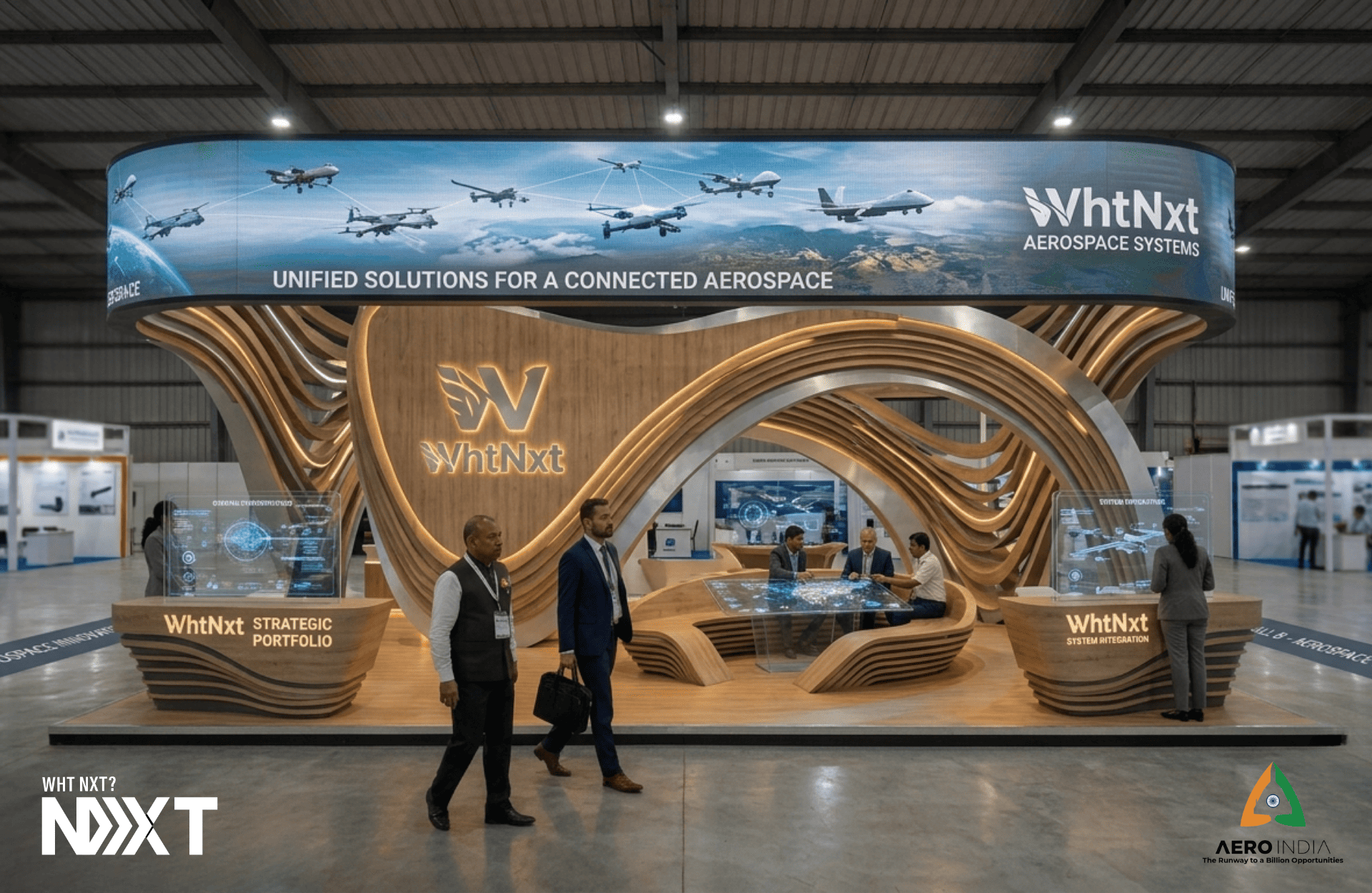
The highest-performing exhibition stands are designed like well-planned visitor journeys.
Rather than asking visitors to "figure it out," they gently guide them through an experience.
Successful stalls typically include:
- Open entrances that eliminate physical and psychological barriers.
- Strong visual storytelling that explains complex technologies in seconds.
- Interactive demonstrations that encourage participation.
- Clear product zoning for easy navigation.
- Comfortable discussion areas for meaningful business conversations.
- Premium lighting and materials that reinforce credibility.
- Strategic branding visible from multiple approaches.
Every design decision should answer one question:
Does this encourage someone to take the next step?
The New ROI of Exhibition Design
For years, exhibition success was measured by booth size.
Today, the most successful brands measure something very different.
They ask:
- How many qualified visitors entered?
- How long did they stay?
- How many demonstrations took place?
- How many meaningful conversations happened?
- How many follow-up meetings were scheduled?
- How many partnerships began on the exhibition floor?
A beautiful booth may win admiration.
An intelligently designed booth generates business.
There is a significant difference.

Leave a comment
Your email address will not be published. Required fields are marked *