In the high-velocity environment of a trade show floor, most brands are invisible. They invest six-figure sums into "expensive wallpaper"—stalls that are aesthetically pleasing but strategically hollow. They mistake decoration for design.
A successful exhibition stall is not a backdrop; it is narrative architecture. It is a physical manifestation of a brand’s strategy, engineered to influence visitor behavior and command cognitive bandwidth. If your stall does not tell a story within the first three seconds of visual contact, you haven’t built a presence; you’ve merely rented floor space.
The Psychology of the Split-Second Filter
The average exhibition visitor is overstimulated and under-focused. Their brain performs a brutal triage of the environment, scanning for relevance, authority, and friction.
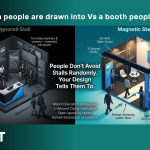
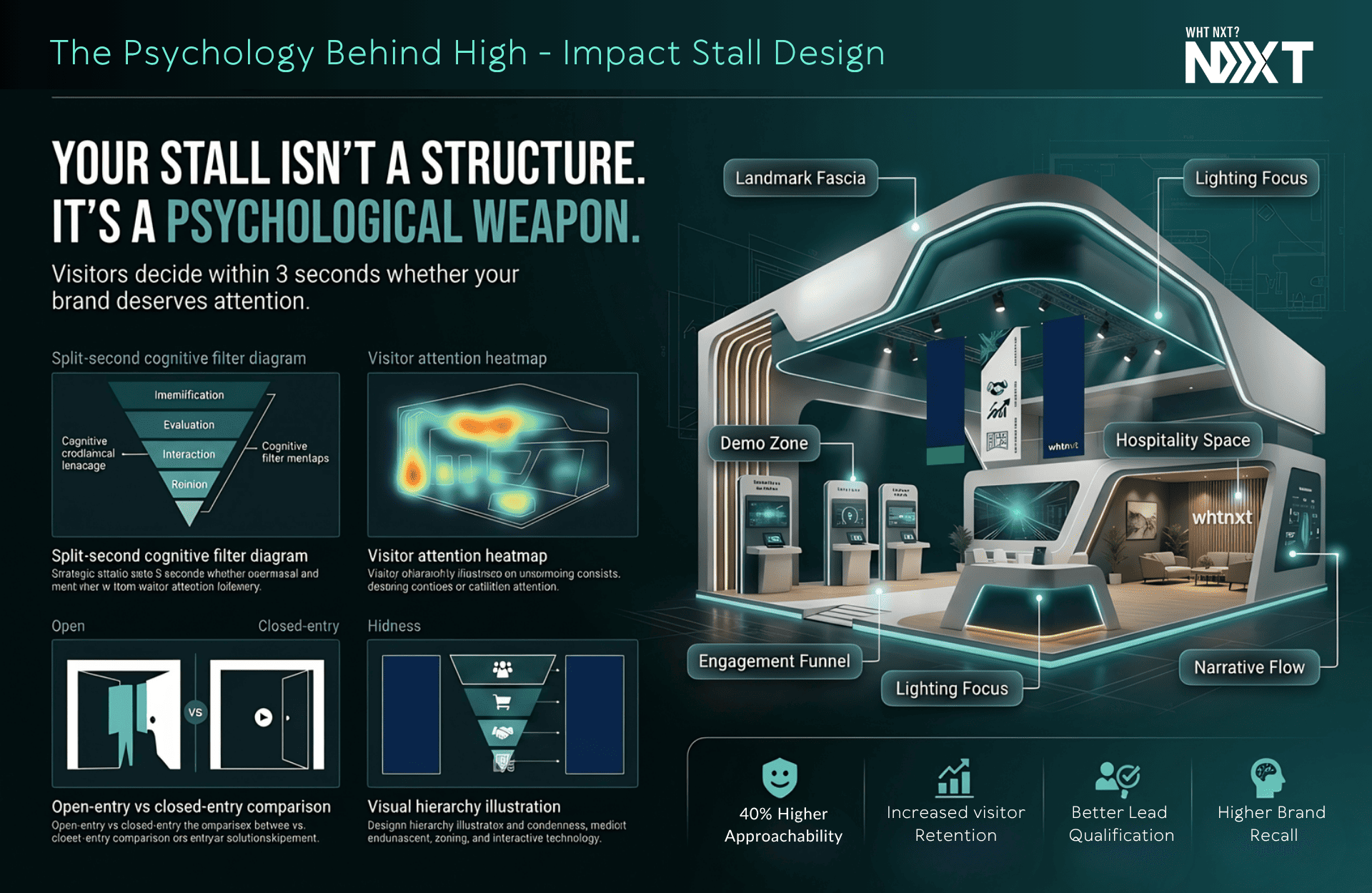
Most stalls fail because they overwhelm this cognitive filter. Cluttered graphics, barricaded entry points (the "reception desk trap"), and confusing layouts signal high effort for the visitor. Psychology dictates that humans gravitate toward clarity and openness. Strategic design exploits this by using visual hierarchy to provide an immediate answer to the visitor’s subconscious question: "Why should I stop here?"
From Displaying Products to Building Experiences
Generic stalls focus on "what" they sell—displaying products like a catalog. Elite stalls focus on "how" the visitor feels. This is the shift from a display to an immersive environment.
When you display a product, you invite a comparison. When you build an experience, you invite a relationship. Narrative architecture uses physical elements to guide a visitor through a deliberate emotional journey:
- The Landmark: A towering structure or high-level hanging fascia isn't just for branding; it is a psychological lighthouse. It establishes dominance and serves as a navigational anchor in a crowded hall.
- The Threshold: Open-entry layouts with no physical barriers lower the psychological cost of entering. A seamless transition from the aisle to the booth floor increases approachability by 40%.
- The Demo Zone: Participation is the ultimate retention tool. Moving a visitor from a passive observer to an active participant through hands-on demo zones creates a "cognitive hook" that outlasts any brochure.
The Subconscious Language of Space
Every material choice and lighting angle communicates brand positioning before a single word is spoken.
Lighting is your most powerful tool for subconscious direction. High-contrast spotlights on a specific innovation zone act as a silent usher, telling the visitor exactly where to look. Conversely, warm, diffused lighting in a hospitality lounge lowers psychological barriers, signaling a safe space for high-value, long-form conversations.
Materiality speaks to maturity. A tech brand using matte finishes and clean industrial lines signals precision. A sustainability-focused brand using organic textures and "breathable" spatial planning signals alignment with its values. If your design contradicts your narrative, the visitor senses a friction they cannot name, but will definitely act upon by walking away.
Flow as a Sales Funnel
A stall should function like a physical sales funnel. The perimeter is for "The Hook"—high-impact visuals and bold statements. The mid-zone is for "The Engagement"—interactive displays and product tactile moments. The inner core is for "The Closing"—secluded, premium zones where the team can qualify leads and discuss ROI without the noise of the floor.
Brochure-heavy stalls are a relic of the past. In a world where technical specs are a QR code away, the physical floor must be reserved for what digital cannot replicate: Presence.
The Narrative Dividend
Storytelling through design does more than just attract crowds; it filters them. A well-architected narrative attracts the right leads—decision-makers who recognize the authority of a brand that has mastered its own story.
When your stall is designed as narrative architecture, you aren't just competing for attention; you are defining the standard of the industry. Brands that treat their booth as a decoration will always be at the mercy of the floor.
The brands that master storytelling through stall design don’t just participate in exhibitions—they dominate them.

एक टिप्पणी छोड़ें
आपका ईमेल पता प्रकाशित नहीं किया जाएगा। आवश्यक फ़ील्ड * से चिह्नित हैं