How to Train Your Exhibition Team for Maximum Impact
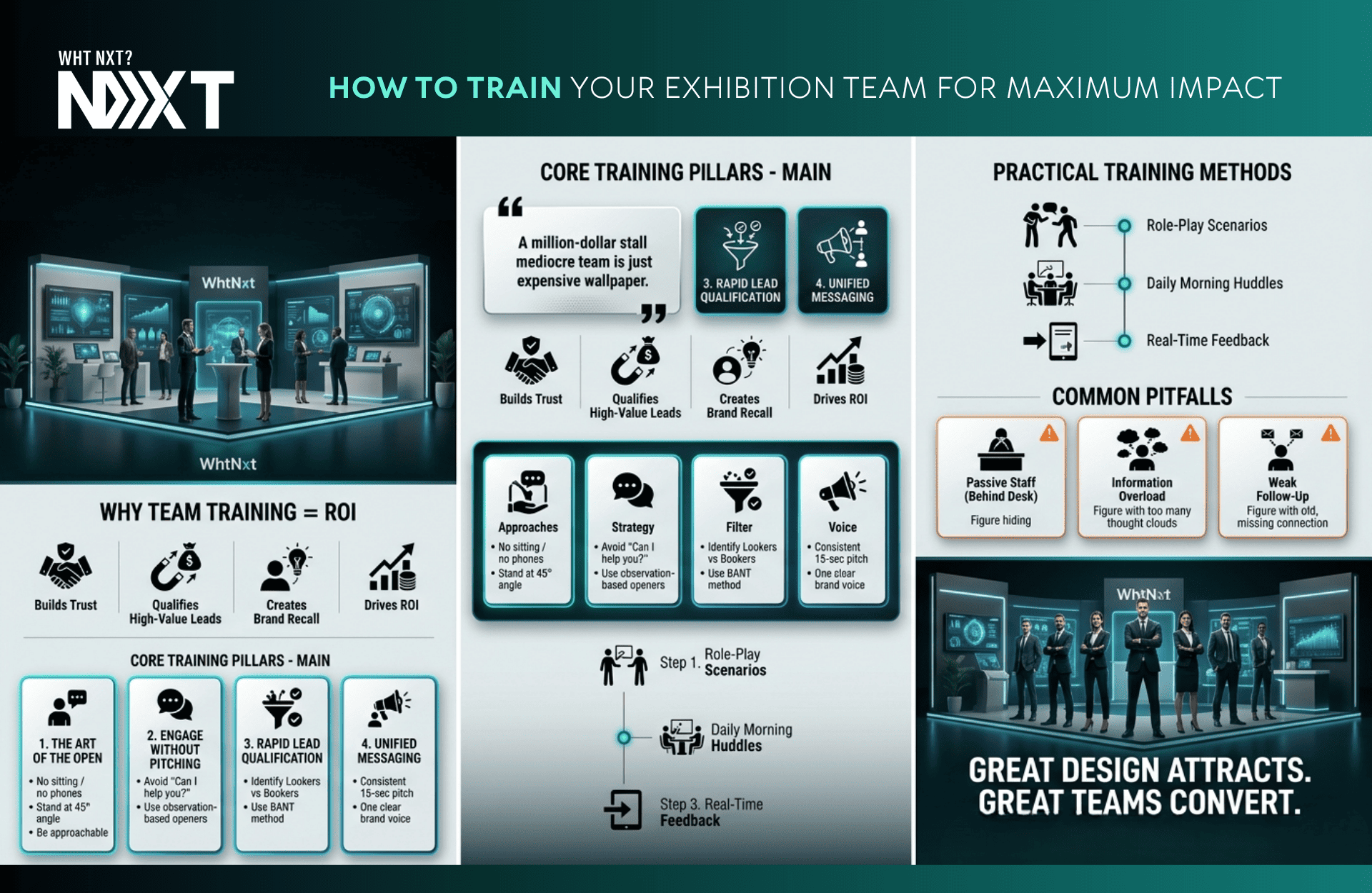
You’ve spent weeks perfecting the floor plan. The branding is sharp, the lighting is cinematic, and that premium entry arch looks exactly like the vision we brought to life for the KTI inauguration. But here is the cold truth: a million-dollar stall with a mediocre team is just expensive wallpaper.
In the high-stakes environment of an exhibition, your booth is the stage, but your team is the performance. If the performance falls flat, the audience walks away.
Why Team Training is Your Secret ROI Weapon
Your team’s behavior is the single biggest variable in your event’s ROI. They aren’t just "manning the booth"—they are the living embodiment of your brand. A well-trained team doesn't just collect business cards; they build trust, qualify high-value leads in seconds, and ensure that every visitor leaves with a positive, lasting memory of your company.
The Core Training Pillars
To turn footfall into a pipeline, your team needs to master these four areas:
1. The Art of the "Open" (Body Language)
First impressions happen in less than three seconds. Training should focus on "approachable" body language:
- The No-Go Zone: No sitting, no scrolling on phones, and no huddling in private circles.
- The Power of the Pivot: Teach staff to stand at a 45-degree angle to the aisle, making it easy for visitors to "drift" into the space.
2. Engaging Without the "Pitch"
Nobody likes a pushy salesperson. Instead of asking, "Can I help you?" (which gets a "No, thanks"), train your team to use open-ended observation.
- Example: "I noticed you were looking at our industrial cooling specs—are you currently managing a large-scale facility?"
3. Rapid Lead Qualification
Time is the most precious resource at an exhibition. Your team needs to identify "Lookers" vs. "Bookers" quickly. Use the BANT method (Budget, Authority, Need, Timeline) to ensure your sales team spends their energy on the leads that actually move the needle.
4. Unified Brand Messaging
Every team member—from the intern to the CEO—should be able to deliver a "15-second elevator pitch" that is consistent. If the messaging is fragmented, the brand looks disorganized.
Practical Training Methods
Don't just hand out a manual; make the training active.
- Role-Playing Scenarios: Throw "difficult" or "distracted" visitor personas at your team during a pre-event workshop. It builds muscle memory.
- Daily Morning Huddles: Spend 10 minutes every morning of the event reviewing the previous day’s wins and identifying any gaps in the flow.
- Real-Time Feedback: If you see a team member missing a cue, pull them aside for a 60-second "course correction" immediately.
Common Pitfalls to Avoid
- The Passive Gatekeeper: Staff standing behind a desk acts as a physical barrier. Get them out in front!
- Information Overload: Don't try to explain the entire company history. Focus on solving one specific problem for the visitor.
- The "Post-Event" Lag: Training must include a mindset for follow-up. A lead is only as good as the speed at which you respond to it.
The Bottom Line
An exhibition is a human-to-human medium. While great design gets people to stop, a great team gets them to stay. Invest in your people as much as you invest in your infrastructure, and you’ll see the difference in your bottom line.
Remember: Your booth is the invitation, but your team is the conversation.

Leave a comment
Your email address will not be published. Required fields are marked *