Most exhibition investments are expensive failures because brands prioritize aesthetics over behavioral engineering. While budgets are poured into custom carpentry and premium flooring, stalls often remain empty because they fail to account for how humans actually move and think on a trade show floor. Successful stalls are not merely decorated; they are engineered around human behavior, attention psychology, and visitor movement.
Why Most Stalls Fail
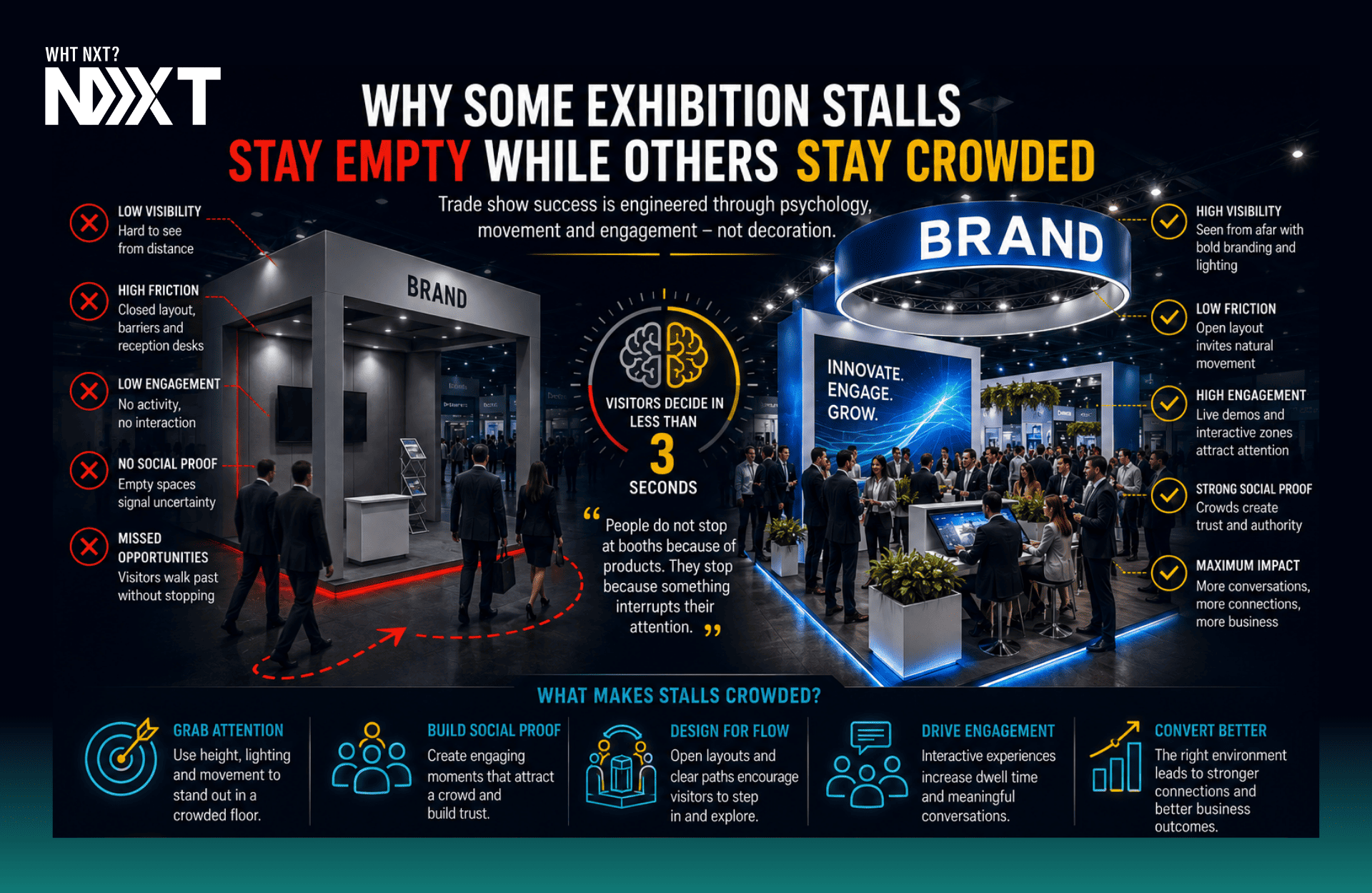
The average visitor decides whether to engage or ignore a booth in less than three seconds. Stalls fail when they create friction—using cluttered graphics that require "reading" rather than "seeing," or defensive furniture layouts that act as physical barriers. When a booth feels like a fortress, visitors stay outside. Trade show success is a perception battle that occurs before a single sales conversation begins.
"People do not stop at booths because of products. They stop because something interrupts their attention."
Visitor Attention Psychology
On a crowded floor, the human brain filters out 90% of the environment to manage sensory overload. To bypass this, brands must use visual anchors like high-altitude branding or lighting rigs to signal their presence from a distance. Once a visitor is near, movement—through kinetic displays or live demos—is essential to hijack focus, as the eye is biologically programmed to track motion.
The Social Proof Effect
Humans are tribal; an empty stall signals uncertainty, while a crowded one signals authority. Crowds are not accidental—they are strategically engineered. By creating "low-stakes" engagement zones, such as interactive demos, brands allow a small crowd to form. This social proof reduces the psychological "cost" of entry for others, making it feel safe for the hesitant majority to enter a populated space.
Open vs. Closed Stall Design
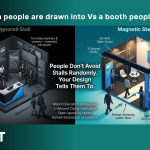
Physical layout functions as a sales funnel. Closed designs create "approach anxiety," whereas open-entry layouts reduce friction. By removing corner pillars and using 360-degree paths, a stall becomes a transition zone where visitors realize they are inside the environment only after they have already begun to engage.
Engagement-Driven Booth Strategy
To maximize dwell time, an environment should be layered:
- The Hook: Uses large-scale lighting and movement to stop the walk-by.
- The Magnet: Interactive demo zones that require participation to create crowd density.
- The Sanctuary: Professional hospitality areas that offer respite and facilitate high-quality sales deep dives.
Designing for Movement and Energy
Lighting should direct focus, using high contrast to create a natural hierarchy of importance for key products. Furthermore, staff should occupy "active" zones near demos rather than "passive" zones like reception desks. Their energy and positioning are the final pieces of the architecture that affect visitor comfort.
The Bottom Line: Brands that master the intersection of spatial flow and behavioral psychology dominate the floor. Those focused only on aesthetics become invisible. Your stall is a machine designed to capture, hold, and convert human attention.

Leave a comment
Your email address will not be published. Required fields are marked *